Readability Score Explained: How to Write Content People Actually Finish
Most visitors do not read a web page. They scan it, decide in a few seconds whether it will answer their question, and leave if it looks like work. An article can be accurate, well researched and properly optimised and still lose its readers at the second paragraph, because the sentences are long and the point is buried.
A readability score estimates how easy a text is to read, usually from two measurements: sentence length and word length. The best known is the Flesch Reading Ease score, where higher is easier and 60 to 70 is considered plain English. To improve readability, shorten long sentences, prefer common words, use the active voice, keep paragraphs short and break text up with headings and lists. A score is a guide to revision, not a target, and it is not a Google ranking factor.
Why readability matters
Reading on a screen is slower and more tiring than reading on paper, and people on the web are usually in the middle of doing something else. Decades of usability research, including the well-known studies from Nielsen Norman Group, have found the same pattern: users scan pages, pick out headings and the first words of paragraphs, and read in full only when they are convinced the page is worth it.
Readable writing respects that. It helps in ways that matter to anyone publishing online:
- More people reach the end. A reader who is never forced to re-read a sentence keeps going.
- Wider audience. Many readers are using a second language, a small screen or a few spare minutes.
- Accessibility. Clear language helps people with dyslexia, cognitive disabilities or screen readers. The W3C's accessibility guidelines include reading level as a success criterion at their highest conformance level.
- Trust. Plain statements sound confident. Tangled ones sound like the writer is hiding something or does not understand the subject.
Google has said that readability scores are not something its ranking systems use directly. What its guidance does ask for is content written for people that leaves them satisfied. Clear writing serves that goal, so treat readability as part of quality, not as a number to optimise.
How readability formulas work
Readability formulas were developed long before the web, mostly for schoolbooks, newspapers and military manuals. Nearly all of them rest on the same two observations: long sentences are harder to follow than short ones, and long or unfamiliar words are harder than short, common ones.
| Formula | What it measures | Result |
|---|---|---|
| Flesch Reading Ease | Average sentence length and syllables per word | A score, typically 0 to 100. Higher is easier. |
| Flesch-Kincaid Grade Level | The same two inputs, weighted differently | A US school grade. Lower is easier. |
| Gunning Fog Index | Sentence length and the share of words with three or more syllables | Years of education needed |
| SMOG | Words of three or more syllables across a sample of sentences | Years of education needed |
| Coleman-Liau and ARI | Characters per word and words per sentence | A US school grade |
The Flesch Reading Ease scale
The formula is: 206.835 − (1.015 × average words per sentence) − (84.6 × average syllables per word). Rudolf Flesch published it in 1948, with this interpretation:
| Score | Description | Typical of |
|---|---|---|
| 90 to 100 | Very easy | Simple children's reading, basic instructions |
| 80 to 89 | Easy | Conversational English |
| 70 to 79 | Fairly easy | Popular fiction, clear consumer writing |
| 60 to 69 | Standard, plain English | Most good web content and news writing |
| 50 to 59 | Fairly difficult | Quality newspapers, business writing |
| 30 to 49 | Difficult | Academic and technical material |
| 0 to 29 | Very confusing | Legal contracts, scientific papers |
The Flesch-Kincaid Grade Level turns the same measurements into a school grade: (0.39 × words per sentence) + (11.8 × syllables per word) − 15.59. A result of 8 means a typical thirteen- or fourteen-year-old could follow the text. Many organisations that write for the general public aim for roughly that level.
What the formulas cannot see
A formula counts. It does not understand. It cannot tell whether your explanation is correct, whether the order makes sense, whether you defined your terms or whether the page looks inviting. "The cat sat on the mat" repeated two hundred times scores superbly. Use the score to find where the text is heavy, then use judgement to fix it.

How to improve readability, step by step
- Lead with the answer. Put the conclusion in the first paragraph. Background can follow for those who want it.
- Cut long sentences in two. Look for "and", "which", "but" and semicolons in any sentence over about 25 words. Most split cleanly there.
- One idea per paragraph. Two to four sentences is comfortable on a phone.
- Swap long words for short ones. Use, not utilise. Help, not facilitate. About, not approximately.
- Prefer the active voice. "The plugin compresses images" is shorter and clearer than "images are compressed by the plugin".
- Define terms once, then keep using the same term. Switching between "page", "post" and "article" for the same thing makes readers wonder whether they differ.
- Use lists and tables for steps, options and comparisons.
- Write headings that say something. "How to clear the cache" tells a scanner more than "Next steps".
- Read it aloud. Wherever you stumble or run out of breath, a reader will too.
Vary sentence length deliberately. A page of nothing but eight-word sentences reads like a telegram. Mostly short, with an occasional longer sentence where the idea needs it, has rhythm and still scores well.
Free readability checker
Paste a paragraph or a whole draft. The checker calculates the Flesch scores, measures your sentences and paragraphs, and points to the specific sentences worth rewriting.
Readability Checker
Free mini tool
Calculates the standard Flesch formulas in your browser. Syllables are estimated with a rule of thumb, so scores can differ by a few points from other tools. It is built for English text, uses no AI and sends nothing anywhere.
Longest sentences
Before and after examples
Example 1: a long opening sentence
"In order to ensure that your website is able to maintain optimal performance levels, it is strongly recommended that the implementation of a caching solution be considered, as this will facilitate a significant reduction in the amount of time that is required for pages to be delivered to visitors."
"Turn on caching. It stores a ready-made copy of each page, so your server can send it to visitors much faster."
The first version is one sentence of 49 words with a passive construction and several long words that add nothing. The second says the same thing in 21 words across two sentences. Nothing was lost except effort for the reader.
Example 2: nominalisations
Turning verbs into nouns is the most common cause of stiff business writing.
| Heavy | Plain |
|---|---|
| We carried out an investigation of the issue | We investigated the issue |
| Make a decision about the configuration | Decide how to configure it |
| There was a failure of the update to install | The update failed to install |
| Provide assistance with the installation | Help install it |
| In the event that the backup is not successful | If the backup fails |
Example 3: structure
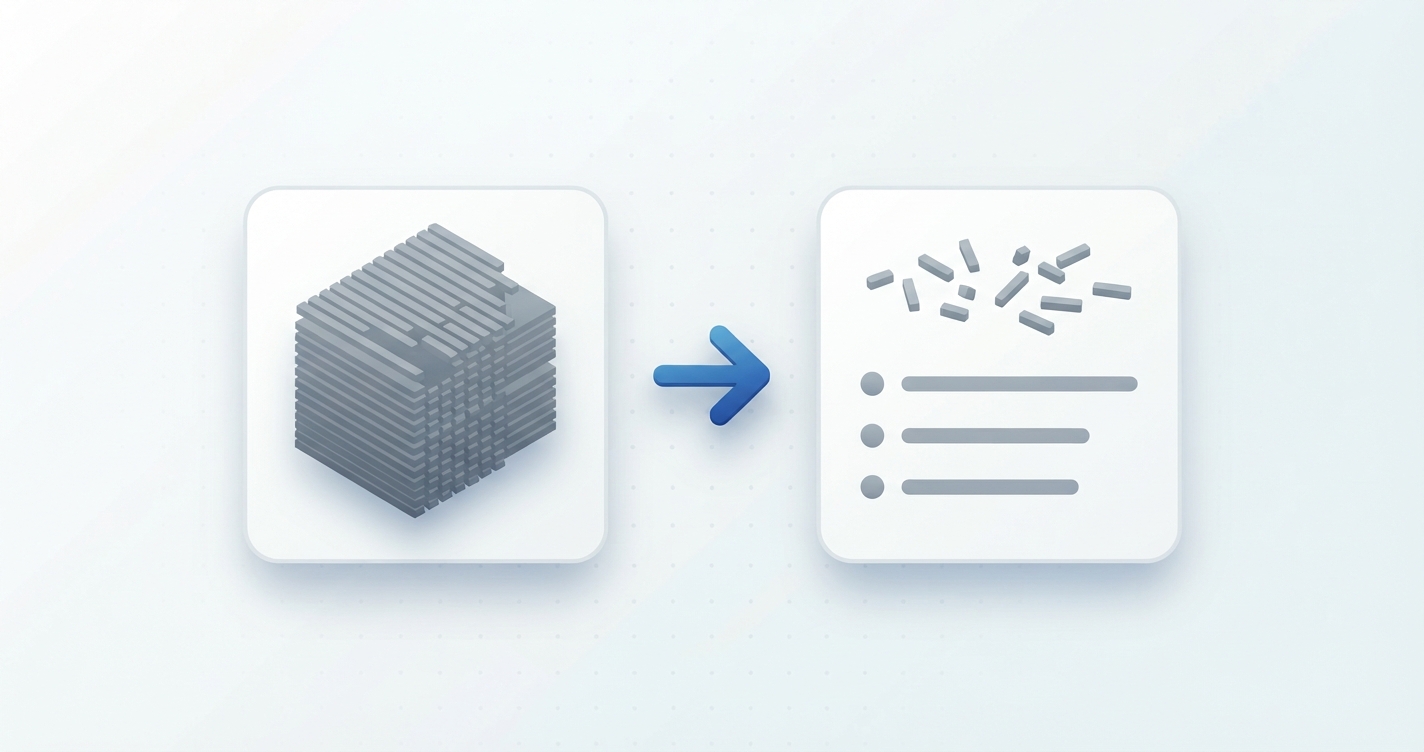
Sometimes the sentences are fine and the layout is the problem. A 200-word paragraph listing six requirements is hard to use. The same content as a short sentence followed by a six-item list is easy, although a formula would score both about the same. That is the part of readability only your eyes can check.
What readability scores are good for
Advantages
- Fast, objective check of sentence and word length
- Points to the densest passages
- Useful for comparing drafts
- Helps teams agree on a house standard
Disadvantages
- Cannot judge accuracy, logic or usefulness
- Penalises necessary technical terms
- Designed for English; unreliable for other languages
- Can be gamed with choppy, lifeless sentences
Who should use them: bloggers, marketers, support teams and anyone writing for a general audience. Who should treat them lightly: writers of specialist material for specialist readers, where precise terminology matters more than a grade level.
Common mistakes
- Writing to the number. Chopping every sentence to hit a score produces text that is easy to read and unpleasant to read.
- Dumbing down. Plain language is not simple thinking. Keep the substance; remove the friction.
- Removing necessary terms. An article about DNS has to say "DNS". Define it once and carry on.
- Ignoring layout. Short sentences in a single unbroken block still look like a wall.
- Front-loading background. Readers who must wade through history to reach the answer leave first.
- Hedging everything. "It may potentially be possible in some cases" says nothing. Commit, or state the specific condition.
- Trusting a passive-voice count blindly. The passive is sometimes right, for instance when the actor is unknown or unimportant.
- Publishing AI drafts unedited. Machine text is often grammatically smooth and padded. Tighten it, and check the facts with our guide to fact-checking AI content.
Advanced tips
- Front-load sentences and headings. Scanners read the first few words. Put the important ones there.
- Write direct answers under question headings. A clear two-sentence answer serves scanners and is also what search features tend to quote. See our guide to featured snippets.
- Check line length and type size. Body text of at least 16 pixels and lines of roughly 50 to 75 characters are comfortable for most readers.
- Use descriptive link text. "Read the caching guide", not "click here".
- Edit in a second pass. Write freely first. Fix readability afterwards, when you can see the whole piece.
- Refresh old posts. Tightening the introduction of an existing article is one of the cheapest improvements you can make. See how to update old blog posts.

Readability checklist
FAQ
For content aimed at the general public, a Flesch Reading Ease score of about 60 to 70, or a Flesch-Kincaid grade of roughly 7 to 9, is a widely used benchmark. Specialist content for expert readers can reasonably score lower.
No. Google has said it does not use readability scores as a ranking signal. Clear writing still matters because it helps readers, and satisfying readers is what Google's guidance asks for.
It is a formula from 1948 that rates English text using average sentence length and average syllables per word. Higher scores mean easier reading; 60 to 70 is described as plain English.
They use the same two measurements. Reading Ease gives a score where higher is easier. Flesch-Kincaid Grade Level converts the result into a US school grade, where lower is easier.
An average of about 15 to 20 words works well, with variety. Treat anything over 25 to 30 words as a candidate for splitting.
No. It means the sentences and words are short. Accuracy, structure, usefulness and originality are separate questions that no formula measures.
The standard Flesch formulas are calibrated for English. Other languages have their own adapted formulas, and results from an English formula should not be relied on for them.
No. Use the active voice by default because it is usually shorter and clearer, and keep the passive where the actor is unknown or irrelevant.
Final recommendation
A readability score tells you where your writing is heavy; it does not tell you whether it is good. Aim for plain English, around 60 to 70 on the Flesch scale for general audiences, and get there by leading with the answer, shortening long sentences, choosing common words and letting headings and lists carry the structure. Paste your next draft into the checker above, fix the three longest sentences, and read the result aloud. That routine takes ten minutes and improves almost any article.
Official references
- Google Search Central: creating helpful, reliable, people-first content
- W3C: Understanding WCAG success criterion 3.1.5, Reading Level
- plainlanguage.gov: Federal plain language guidelines
- Nielsen Norman Group: how users read on the web
Related articles
ContentContent brief template
SEOHow to update old blog posts
Next step
Check the introduction of your most visited post in the tool above and rewrite what it flags. Then make sure the page matches what searchers want with our guide to search intent.